
Urinary catheterization is a hands-on nursing skill that requires students to coordinate clinical knowledge, patient care, aseptic technique, and procedural skills.
For nursing students, practicing the procedure step by step can help build consistency before a skills-lab assessment or clinical placement. A structured urinary catheterization skills checklist can also help instructors evaluate whether students are performing the key steps correctly and identify specific areas that need more practice.
The exact checklist used by a nursing program may vary according to the type of catheterization, patient population, institutional policy, and clinical guidelines. The checklist below provides a general framework for skills-lab practice and competency assessment rather than a substitute for an institution's approved clinical procedure.
Urinary Catheterization Skills Checklist
A urinary catheterization competency assessment can be organized into four stages:
- Before catheter insertion
- During catheter insertion
- After catheter insertion
- Catheter removal and follow-up, when applicable
This structure reflects the way urinary catheterization checklists are commonly organized in nursing education and clinical training. Standardized checklists may be used to assess procedural steps and aseptic technique during catheter insertion.
1. Before Catheter Insertion
Patient and Procedure Preparation
Before beginning the procedure, the student should be able to:
☐ Verify the indication or order according to the assigned scenario
☐ Confirm patient identity according to institutional policy
☐ Explain the procedure and its purpose
☐ Explain what the patient may experience during the procedure
☐ Provide an opportunity for questions
☐ Provide appropriate privacy
☐ Gather the required equipment and supplies
☐ Select the appropriate catheter and size according to the assigned procedure
☐ Check the catheter package and supplies
☐ Prepare the drainage system when applicable
☐ Perform hand hygiene
☐ Apply appropriate personal protective equipment
Appropriate catheter selection and preparation are part of standardized catheter-insertion checklists. AHRQ's indwelling urinary catheter insertion checklist, for example, includes confirming the catheter and balloon size, assembling supplies, identifying the patient, explaining the procedure, providing privacy, and positioning the patient before insertion.
Patient Positioning
The student should be able to:
☐ Position the patient appropriately for the procedure
☐ Maintain privacy and dignity
☐ Provide adequate lighting and visualization
☐ Adjust positioning according to male or female anatomy
☐ Maintain the patient's comfort as much as possible
☐ Request assistance with positioning when needed
Appropriate positioning supports visualization of the urethral area and helps reduce unnecessary movement during the procedure.
2. Aseptic Technique
Aseptic technique is a central part of indwelling urinary catheter insertion and should be evaluated as a specific competency rather than treated as a minor procedural detail. AHRQ identifies aseptic technique during catheter insertion as an important component of infection prevention.
Students should be able to:
☐ Perform hand hygiene at the appropriate points
☐ Prepare the required sterile supplies
☐ Establish and maintain a sterile field as required
☐ Apply sterile gloves when required
☐ Handle sterile equipment appropriately
☐ Avoid contaminating the catheter
☐ Maintain appropriate aseptic technique during insertion
☐ Recognize when equipment or the catheter has become contaminated
☐ Replace contaminated equipment according to the procedure
A skills assessment should evaluate not only whether the catheter was inserted successfully, but also whether the student maintained the required technique throughout the procedure.
3. Anatomical Identification
Before insertion, students should demonstrate an understanding of the anatomy involved.
General Anatomy
☐ Identify the urethral meatus
☐ Identify relevant surrounding structures
☐ Understand the general pathway of the urethra
☐ Understand the location of the bladder
☐ Recognize relevant male and female anatomical differences
Female Catheterization
Students may need to demonstrate the ability to:
☐ Identify the urethral opening
☐ Maintain appropriate visualization of the urethral area
☐ Distinguish the urethral opening from surrounding structures
Male Catheterization
Students may need to demonstrate the ability to:
☐ Identify the urethral meatus
☐ Position the penis appropriately according to the procedure taught
☐ Recognize relevant male urethral anatomy
Anatomical identification is particularly important during simulation training because students can practice locating the meatus before attempting the complete insertion procedure.
4. Catheter Preparation and Handling
Before insertion, students should demonstrate appropriate catheter handling.
☐ Open the catheterization supplies using the required technique
☐ Prepare the sterile field
☐ Lubricate the catheter as required
☐ Maintain control of the catheter
☐ Avoid contaminating the catheter
☐ Prepare the drainage system when applicable
☐ Maintain appropriate hand positioning throughout insertion
The purpose of repeated simulation practice is not simply to memorize these steps. Students should develop the hand control and coordination needed to perform them consistently.
5. Catheter Insertion
During catheter insertion, students should demonstrate that they can:
☐ Identify the urethral meatus before insertion
☐ Maintain appropriate positioning
☐ Introduce the catheter using the technique taught by the program
☐ Advance the catheter appropriately
☐ Maintain appropriate catheter control
☐ Recognize expected resistance
☐ Avoid forcing the catheter
☐ Recognize when catheter placement has been achieved
☐ Recognize simulated urine return when supported by the training model
AHRQ's insertion checklist specifically includes identifying the meatus, cleaning the meatus using the required technique, lubricating the catheter, advancing the catheter until urine return, and avoiding force if resistance is encountered.
6. Recognizing Correct Catheter Placement
Students should understand how successful catheter placement is identified within the training scenario.
☐ Recognize the expected endpoint of catheter advancement
☐ Recognize simulated urine return when available
☐ Understand the relationship between catheter position and urine drainage
☐ Avoid proceeding with subsequent steps when placement is uncertain
☐ Seek assistance when appropriate if catheter placement is unsuccessful or uncertain
Functional urinary catheterization trainers can provide simulated urine return, allowing instructors and students to observe an immediate response during practice.
7. Foley Catheter and Balloon Skills
When the learning objective includes indwelling Foley catheterization, balloon-related skills should be assessed separately.
Students should be able to:
☐ Confirm appropriate catheter placement before balloon inflation
☐ Identify the balloon inflation port
☐ Use the appropriate inflation solution and volume according to the catheter and procedure
☐ Inflate the balloon according to the procedure taught
☐ Maintain appropriate catheter position during and after balloon inflation
☐ Recognize when the balloon step is not applicable
Balloon inflation should only be practiced on a training model designed to support this function. Students should follow the catheter manufacturer's instructions and their nursing program's approved procedure.
AHRQ's insertion checklist includes confirming catheter and balloon size before insertion and balloon inflation after urine return and appropriate catheter placement.
8. Drainage System Management
Catheterization competency continues after the catheter has been inserted.
Students should demonstrate that they can:
☐ Connect the catheter to the drainage system correctly
☐ Maintain the closed drainage system when applicable
☐ Check the tubing for obstruction or kinking
☐ Maintain appropriate tubing position
☐ Keep the drainage bag below the level of the bladder
☐ Avoid unnecessary tension on the catheter
☐ Observe urine drainage
☐ Recognize simulated drainage problems
AHRQ's catheter maintenance guidance emphasizes maintaining an unobstructed drainage system, appropriate securement, and keeping the drainage bag below bladder level.
9. Catheter Securement
Students should understand how appropriate catheter securement helps maintain catheter position and reduce unnecessary traction.
The checklist may include:
☐ Secure the catheter according to institutional protocol
☐ Position the securement device appropriately
☐ Avoid unnecessary tension on the catheter
☐ Maintain appropriate tubing alignment
☐ Recheck the catheter and drainage setup after securement
Catheter securement and unobstructed drainage are included in established catheter-care guidance.
10. Post-Procedure Care
After catheter insertion, students should be able to:
☐ Remove and dispose of used supplies appropriately
☐ Remove gloves appropriately
☐ Perform hand hygiene
☐ Return the patient to a comfortable position
☐ Maintain privacy and dignity
☐ Check the catheter and drainage system
☐ Confirm that tubing is not kinked
☐ Confirm that the drainage bag is positioned appropriately
☐ Assess patient comfort
☐ Communicate relevant findings according to the assigned scenario
These steps help ensure that catheterization training covers the complete procedure rather than ending immediately after successful insertion.
11. Catheter Removal
When catheter removal is included in the learning objective, students should demonstrate that they understand the appropriate removal sequence.
☐ Confirm that catheter removal is indicated according to the assigned scenario
☐ Explain the procedure
☐ Prepare the required equipment
☐ Perform appropriate hand hygiene and apply required PPE
☐ Deflate the Foley balloon when applicable
☐ Confirm that the balloon has been fully deflated according to the procedure
☐ Remove the catheter using the technique taught by the program
☐ Dispose of equipment appropriately
☐ Perform post-removal care
☐ Monitor or report relevant findings according to the clinical scenario
Catheter removal may be assessed separately from insertion. Nursing education research has used urinary catheterization skill checklists that include dedicated catheter-removal items as part of overall student competency assessment.
12. Documentation and Reporting
A complete catheterization competency assessment should not necessarily end when the physical procedure is finished.
Depending on the clinical or simulation scenario, students may need to demonstrate that they can:
☐ Record the catheter type and size when required
☐ Record balloon volume when applicable
☐ Record the amount of urine obtained when required
☐ Describe relevant urine characteristics when required
☐ Record patient tolerance
☐ Document the procedure according to institutional policy
☐ Report unexpected findings or difficulties
☐ Record the date, time, and person performing the procedure when required
Documentation requirements vary by institution and clinical setting. AHRQ's sample insertion checklist includes catheter and balloon information, fluid used for balloon inflation, urine obtained and characteristics, patient tolerance, and information about the person performing the insertion.
Urinary Catheterization Skills Checklist for Nursing Students
The following condensed checklist can be used for skills-lab practice or instructor observation.
| Skill | Practice / Assessment |
| Verify indication or order | ☐ |
| Confirm patient identity | ☐ |
| Explain the procedure | ☐ |
| Provide privacy and dignity | ☐ |
| Prepare equipment and supplies | ☐ |
| Select appropriate catheter | ☐ |
| Perform hand hygiene | ☐ |
| Apply appropriate PPE | ☐ |
| Position the patient appropriately | ☐ |
| Identify relevant anatomy | ☐ |
| Identify the urethral meatus | ☐ |
| Prepare and maintain the sterile field | ☐ |
| Maintain aseptic technique | ☐ |
| Prepare and lubricate the catheter | ☐ |
| Handle the catheter correctly | ☐ |
| Insert the catheter appropriately | ☐ |
| Recognize appropriate catheter placement | ☐ |
| Recognize simulated urine return | ☐ |
| Inflate Foley balloon when applicable | ☐ |
| Connect the drainage system | ☐ |
| Maintain appropriate tubing position | ☐ |
| Secure the catheter | ☐ |
| Keep the drainage system unobstructed | ☐ |
| Maintain the drainage bag below bladder level | ☐ |
| Assess patient comfort | ☐ |
| Complete post-procedure care | ☐ |
| Remove the catheter when applicable | ☐ |
| Complete required documentation | ☐ |
| Report unexpected findings | ☐ |
This checklist can be adapted for male or female catheterization, straight or indwelling catheterization, and different patient populations according to the learning objectives of the program.
How to Use the Checklist in a Nursing Skills Lab
A checklist can be used at different stages of nursing skills training.
1. Initial Practice
Students can use the checklist to become familiar with the complete sequence before performing the procedure independently.
The instructor can demonstrate the procedure first and explain which steps are critical for patient safety and infection prevention.
2. Repeated Simulation Practice
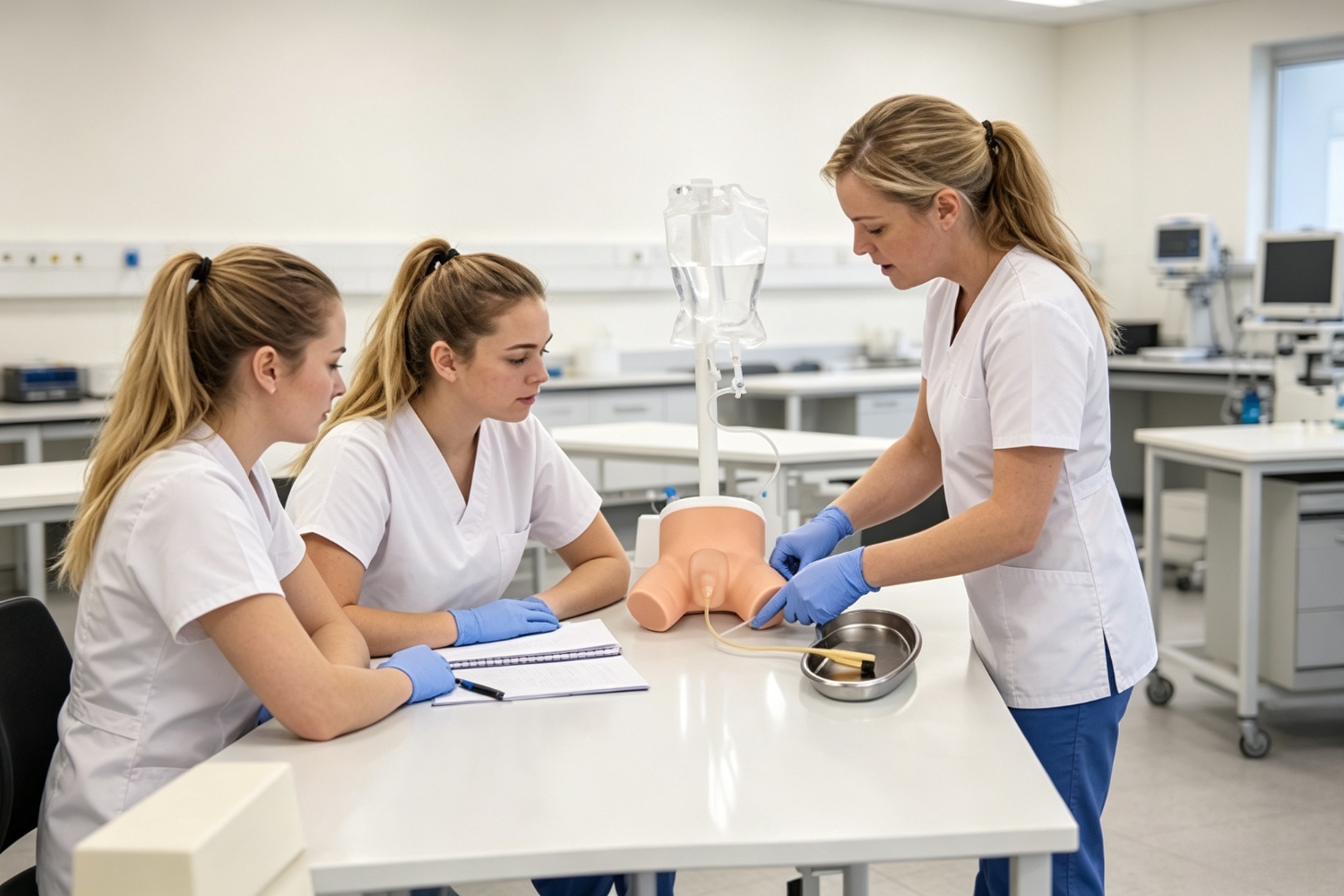
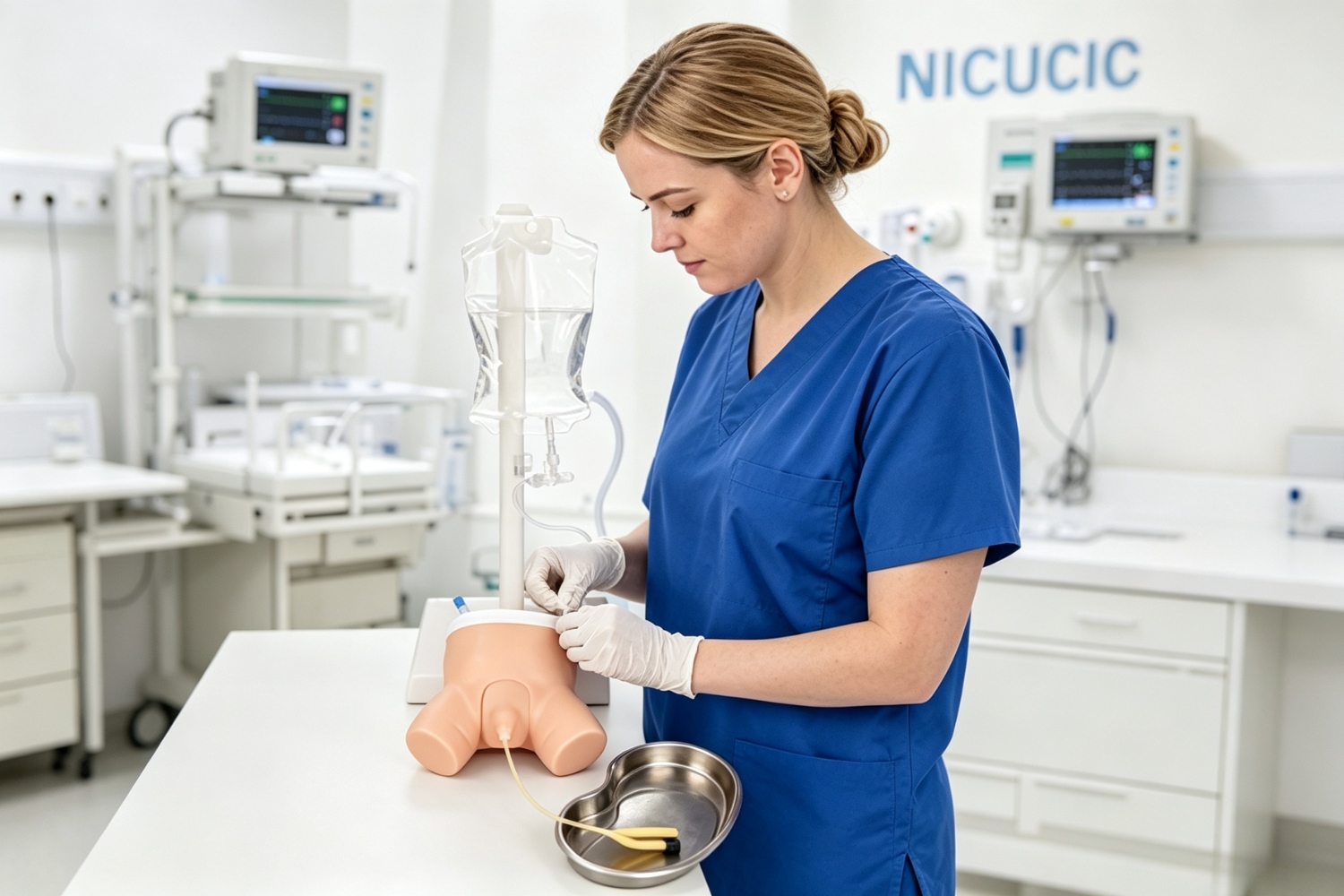
Students can then practice the procedure on a urinary catheterization trainer.
Instead of repeating the entire procedure without feedback, instructors can focus on individual competencies such as:
- Meatus identification
- Catheter handling
- Catheter positioning
- Aseptic technique
- Recognition of urine return
- Foley balloon inflation
- Drainage management
- Catheter securement
Repeated hands-on practice can help students develop consistency before clinical application.
3. Instructor Assessment
During an observed skills assessment, the instructor can mark each checklist item as:
- Competent
- Needs Practice
- Not Applicable
A more detailed program-specific checklist may also use scoring criteria for each step.
Research in nursing education has used urinary catheterization insertion skill checklists with multiple observable items and scoring categories to assess student performance.
4. Competency Validation
Before students progress to clinical practice, the checklist can help instructors determine whether the required competencies have been demonstrated.
The exact passing criteria should be established by the nursing program rather than by a generic checklist.
What Can Students Practice on a Urinary Catheterization Trainer?
A urinary catheterization trainer can provide a controlled environment for practicing many of the observable skills included in a checklist.
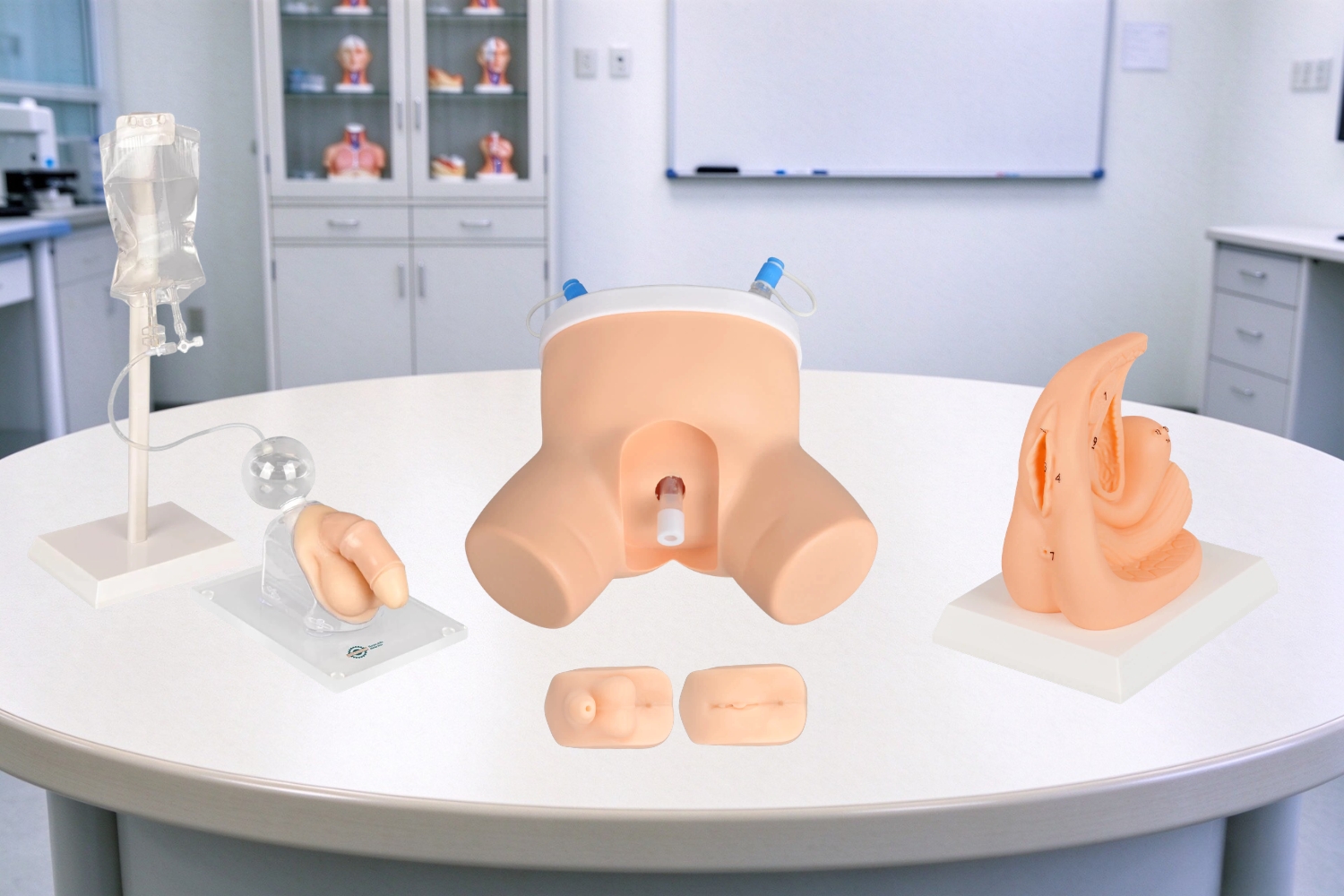
Depending on the model, students may practice:
- Anatomical identification
- Meatus identification
- Male catheterization
- Female catheterization
- Catheter handling and positioning
- Foley catheter insertion
- Balloon inflation
- Recognition of simulated urine return
- Drainage system management
- Catheter fixation
- Catheter removal
- Difficult catheterization scenarios
- Infant catheterization
- Geriatric catheterization
Not every training model supports every skill. For example, balloon inflation and simulated urine return require a model designed specifically for those functions.
For this reason, educators should match the training model to the competencies students are expected to demonstrate.
Frequently Asked Questions
Q1: What is a urinary catheterization skills checklist?
A urinary catheterization skills checklist is a structured tool used to break the procedure into observable steps that can be practiced and assessed. In nursing education, it can be used during skills-lab practice, simulation, instructor observation, and competency assessment.
Q2: What should nursing students be assessed on during urinary catheterization?
Assessment can include preparation, patient positioning, anatomical identification, aseptic technique, catheter handling, insertion, recognition of placement, Foley balloon inflation when applicable, drainage management, securement, removal, documentation, and patient communication.
Q3: Is aseptic technique part of urinary catheterization competency?
Yes. Aseptic technique is a major component of indwelling urinary catheter insertion and is included in established catheter-insertion checklists and training resources.
Q4: Should balloon inflation be included in the checklist?
Yes, when students are learning Foley catheterization and the training model supports this function. Balloon inflation should be assessed only after appropriate catheter placement and according to the applicable procedure.
Q5: Can this checklist be used for both male and female catheterization?
Yes. The general checklist can be adapted to both. Anatomy-specific positioning, meatus identification, and insertion considerations should be incorporated into the relevant procedure.
Q6: Can students use the checklist with a simulation model?
Yes. A urinary catheterization trainer allows students to practice observable procedural skills repeatedly in a controlled environment. The checklist can be used by students for self-practice or by instructors during assessment.
Q7: Is catheter removal part of urinary catheterization competency?
It can be. Some nursing education checklists assess removal as part of the overall catheterization skill, while others evaluate insertion and removal separately. The appropriate approach depends on the curriculum and assessment requirements.
Q8: Is documentation included in catheterization checklists?
It may be. Clinical checklists can include documentation of catheter type and size, balloon volume, urine obtained, patient tolerance, and other procedure-specific information. Requirements vary by institution and clinical setting.
A urinary catheterization skills checklist helps nursing students turn a complex clinical procedure into a series of observable skills that can be practiced, reviewed, and assessed.
Using a structured checklist together with hands-on simulation allows students to identify specific areas that need improvement instead of treating catheterization as a single skill.
For nursing schools, simulation centers, and clinical education programs, Urinary Catheterization Trainers can provide a controlled environment for repeated practice of catheterization skills before students apply them in clinical settings.
.jpeg?w=1500&h=1500)
.jpeg?w=1600&h=1600)
.jpeg?w=1500&h=1500)
.jpeg?w=1600&h=1600)
.jpg?w=1600&h=1600)
.jpg?w=1600&h=1600)
.jpg?w=1600&h=1600)
.jpg?w=1600&h=1600)
.jpg?w=1500&h=1500)
.jpg?w=1500&h=1500)
.jpg?w=1600&h=1600)
-0.jpg?w=1500&h=1500)
.jpeg?w=1600&h=1600)
.jpeg?w=1600&h=1600)
.jpeg?w=1600&h=1600)
.jpeg?w=1600&h=1600)
.jpeg?w=1600&h=1600)
.jpeg?w=1600&h=1600)
.jpg?w=1600&h=1600)
.jpg?w=1600&h=1600)
.jpg?w=1000&h=1000)
.jpg?w=1000&h=1000)

.jpeg?w=1500&h=1500)
.jpeg?w=1500&h=1500)


.jpeg?w=1600&h=1600)
.jpeg?w=1600&h=1600)
.jpg?w=1600&h=1600)
.jpg?w=1600&h=1600)
.jpg?w=1500&h=1500)
.jpg?w=1500&h=1500)
.jpg?w=1500&h=1500)
.jpg?w=1500&h=1500)
.jpg?w=1500&h=1500)
.jpg?w=1500&h=1500)