
Urinary catheterization is a hands-on clinical skill that requires more than memorizing the steps of the procedure. Learners need to understand urinary anatomy, identify the urethral opening, control catheter movement, maintain appropriate technique, recognize correct placement, and manage the catheter and drainage system.
A urinary catheterization training model provides a controlled environment where nursing students and healthcare trainees can practice these skills repeatedly before performing catheterization in clinical care.
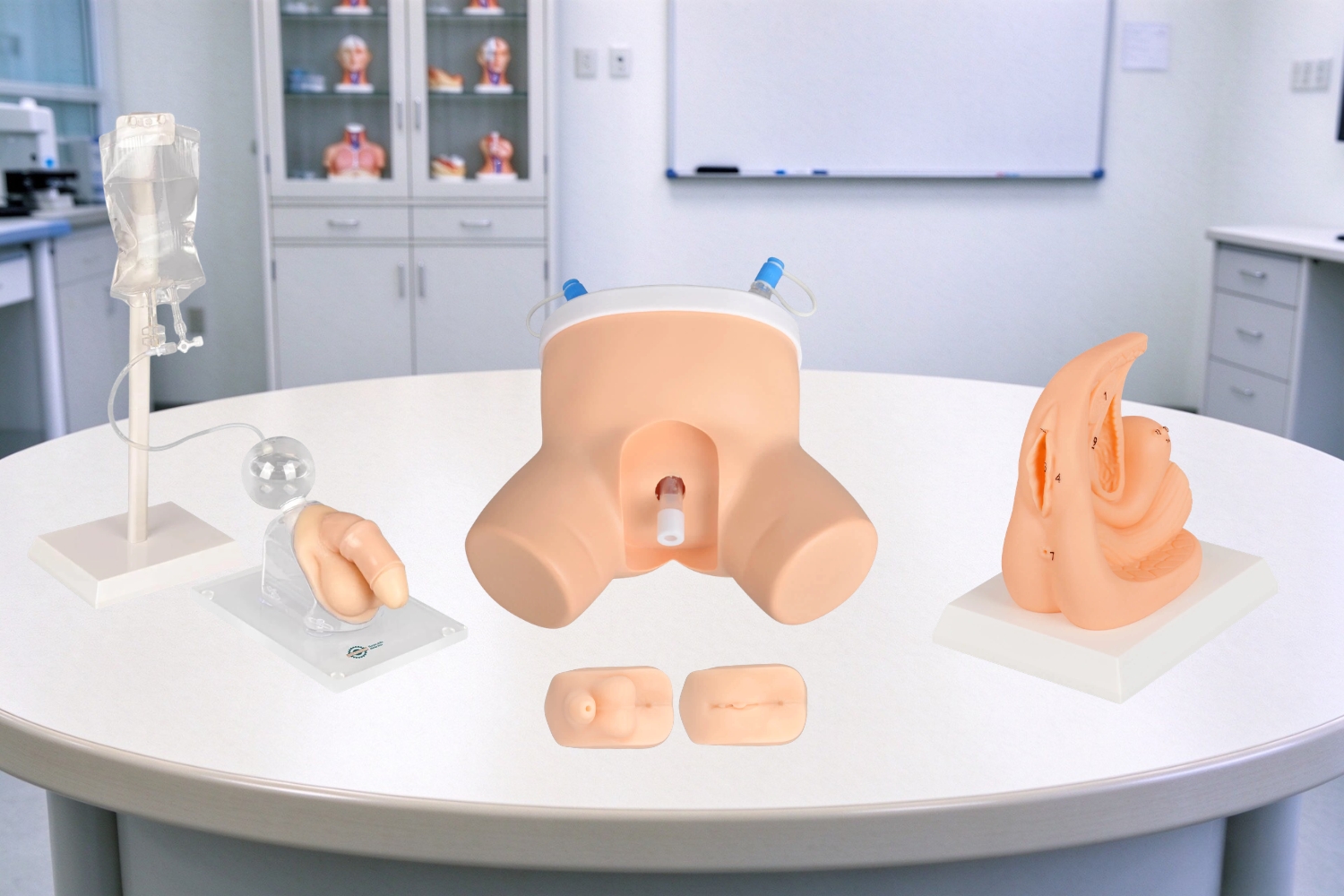
MedEduQuest offers a range of urinary catheterization training models for adult male and female catheterization, infant care, geriatric scenarios, anatomical instruction, and repeated hands-on practice.
What Skills Can You Practice?
The specific skills supported depend on the design of the training model. Some models are intended primarily for anatomy instruction and insertion practice, while functional models may include fluid systems, interchangeable anatomy, or features for more advanced urinary-care procedures.
Depending on the model, learners can practice the following skills.
1. Male Urinary Catheterization
Male urinary catheterization requires learners to understand male urethral anatomy, maintain appropriate positioning, and control catheter advancement through the simulated urethra.
Training models can help learners practice:
- Identifying relevant male urinary anatomy
- Positioning the patient or training model
- Handling and advancing the catheter
- Maintaining appropriate catheter positioning
- Recognizing simulated urine return when supported
- Securing and managing the catheter and drainage tubing
A dedicated male urinary catheterization trainer can provide repeated practice without requiring access to a live patient.
2. Female Urinary Catheterization
Female urinary catheterization requires accurate identification of the urethral opening and appropriate catheter positioning.
Learners can practice:
- Identifying the urethral opening
- Positioning the patient or model
- Maintaining appropriate hand control
- Advancing the catheter through the simulated urethra
- Recognizing correct placement
- Managing catheter fixation and drainage
For programs that teach both male and female catheterization, interchangeable models can allow learners to practice and compare the two anatomical configurations.
3. Foley Catheter Insertion
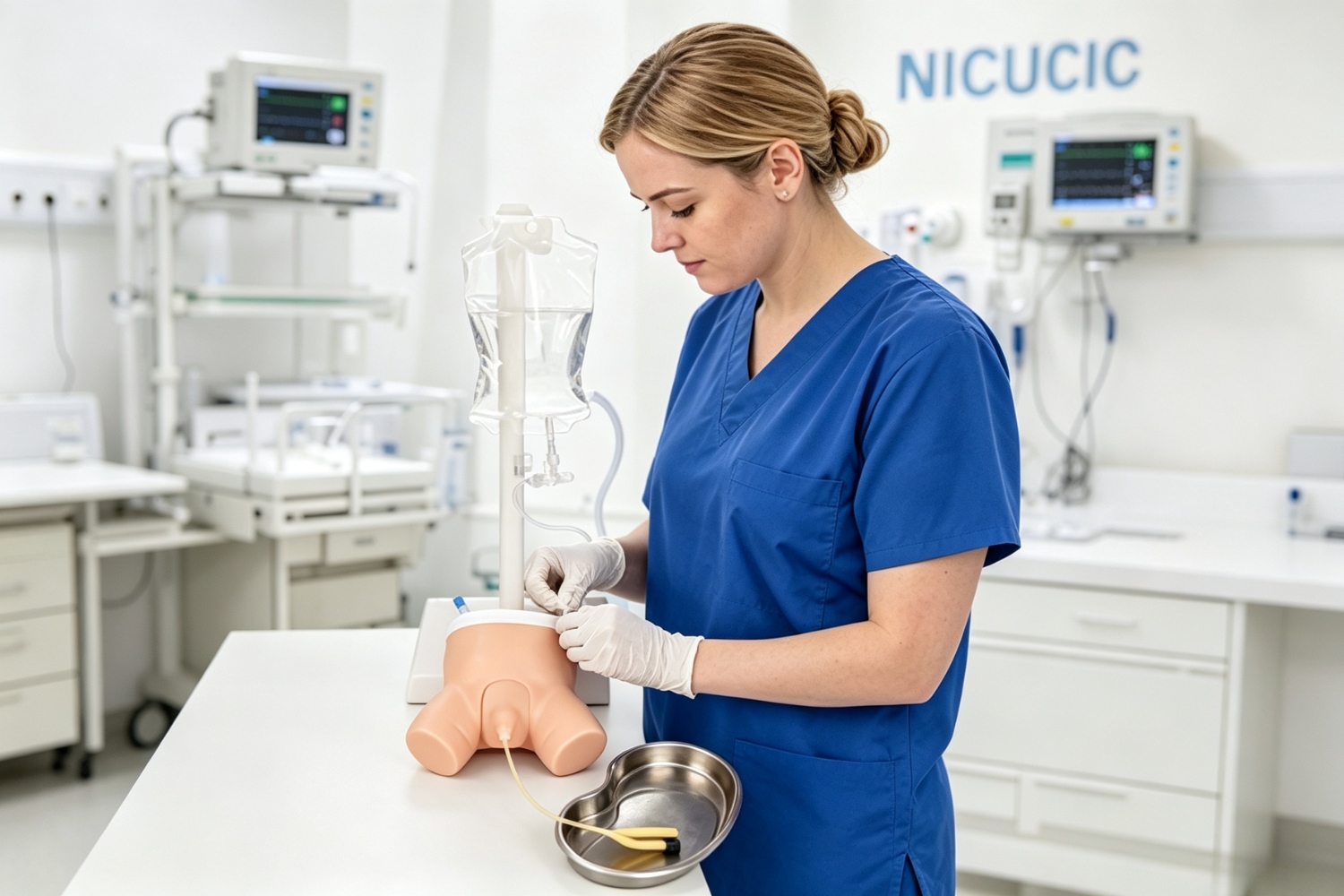
Foley catheter insertion involves more than advancing a catheter into the bladder. Learners also need to understand catheter positioning and the steps associated with placement of an indwelling catheter.
On compatible Foley catheter training models, learners may practice:
- Preparing and handling a Foley catheter
- Advancing the catheter to the appropriate position
- Recognizing simulated urine return
- Practicing balloon inflation after appropriate placement
- Connecting the drainage system
- Securing the catheter and tubing
The exact steps practiced should follow the learner's institutional protocol and applicable clinical guidelines.
4. Catheter Positioning
Correct catheter positioning is an important part of catheterization training.
Depending on the model, learners can practice:
- Maintaining appropriate catheter alignment
- Advancing the catheter through the simulated urethra
- Recognizing resistance during insertion
- Identifying the appropriate depth of insertion
- Maintaining catheter position during drainage
- Checking the catheter and tubing after placement
Models with transparent components or fluid feedback can provide additional visual information during practice.
For example, the Male Urethral Catheterization Training Kit allows learners to practice catheter placement while observing the catheter's position through its transparent design.
5. Balloon Inflation
For Foley catheter training, learners may also need to practice balloon inflation after the catheter has reached the appropriate position.
On compatible training models, learners can practice:
- Recognizing when the catheter is appropriately positioned
- Performing the balloon inflation step
- Understanding the relationship between catheter position and balloon placement
- Maintaining the catheter in the correct position after inflation
This skill should only be practiced on models specifically designed to support Foley catheter balloon training. Learners should follow the catheter manufacturer's instructions and their training program's clinical protocol.
6. Urine Drainage and Simulated Urine Return
Functional catheterization models may provide simulated urine return when the catheter is correctly positioned.
This allows learners to practice:
- Recognizing simulated urine return
- Connecting the drainage system
- Observing fluid drainage
- Managing the drainage tubing
- Checking whether the catheter is functioning as expected
Immediate fluid feedback can help instructors identify positioning or procedural errors during skills practice.
The Male & Female Urinary Catheterization Simulator provides visible urine return during practice and supports both male and female configurations.
7. Catheter Removal
Catheterization training can also include the steps involved in catheter removal.
Depending on the model, learners may practice:
- Preparing for catheter removal
- Managing the catheter and drainage system
- Performing the appropriate removal sequence
- Handling the catheter after removal
- Completing the procedure according to institutional protocol
Including removal in a skills session allows learners to practice the complete catheterization workflow rather than focusing only on insertion.
8. Aseptic Technique
Aseptic technique is an important component of urinary catheterization training. A simulation model can provide a controlled setting for practicing the procedural sequence while learners apply the infection-prevention principles taught by their program.
Training sessions may incorporate:
- Preparing the required equipment
- Maintaining a clean or sterile field as required by the procedure
- Handling the catheter without contaminating it
- Maintaining appropriate technique during insertion
- Managing equipment and supplies after the procedure
The specific aseptic technique requirements should follow institutional policies and applicable clinical guidelines. The training model supports hands-on procedural practice, but infection-prevention competency also depends on the learner's overall technique and knowledge.
9. Meatus Identification
Accurate identification of the urethral opening is an important step before catheter insertion.
Models can help learners practice:
- Locating the urethral meatus
- Identifying surrounding anatomical structures
- Distinguishing the urethral opening from nearby structures
- Understanding anatomical differences between male and female patients
- Working with less visible anatomy in more challenging scenarios
Labeled anatomical models can be particularly useful during introductory instruction.
For example, the Male Urinary Catheterization Model with Labeled Structures provides a visual reference for the urethral pathway and related anatomy.
10. Catheter Fixation and Tubing Management
Catheter care continues after successful insertion. Learners may need to practice how the catheter and drainage tubing are managed after placement.
Depending on the model and training setup, learners can practice:
- Securing the catheter appropriately
- Connecting the drainage tubing
- Maintaining appropriate tubing position
- Avoiding unnecessary tension on the catheter
- Managing the drainage system
- Observing simulated urine drainage
These skills are particularly useful in nursing skills labs because they extend the training scenario beyond the insertion step.
11. Difficult Catheterization
Some patients present anatomical or age-related challenges that are not represented by a standard catheterization model.
Specialized models can be used to practice difficult catheterization scenarios, including:
- Identifying a less visible urethral opening
- Working with age-related anatomical changes
- Adjusting positioning
- Maintaining appropriate tissue handling
- Recognizing increased difficulty during insertion
- Managing the catheter when placement is more challenging
The Geriatric Female Catheterization Trainer simulates age-related changes including vulvar atrophy, reduced tissue elasticity, and a recessed urethral opening.
These features provide a more challenging scenario for nursing and geriatric-care training.
12. Suprapubic Catheter Care
Some multifunctional urinary-care simulators support training beyond routine urethral catheterization.
Depending on the model, learners may practice:
- Suprapubic catheter care
- Cleaning around the suprapubic site
- Dressing changes
- Catheter and tubing management
- Observing the catheter and surrounding site
- Managing the drainage system
These skills can be incorporated into broader urinary-care training for nursing and healthcare programs.
13. Suprapubic Bladder Puncture
Advanced urinary catheterization simulators may also support suprapubic bladder puncture practice.
This can allow learners to become familiar with:
- Identifying the simulated bladder location
- Understanding the anatomical relationship between the bladder and abdominal wall
- Practicing the suprapubic access procedure
- Recognizing simulated fluid return where supported
- Managing the catheter or access site after the procedure
For example, the MedEduQuest Male & Female Urinary Catheterization Simulator supports suprapubic bladder puncture and suprapubic catheter care in addition to routine catheterization practice.
How These Skills Fit into Nursing Education
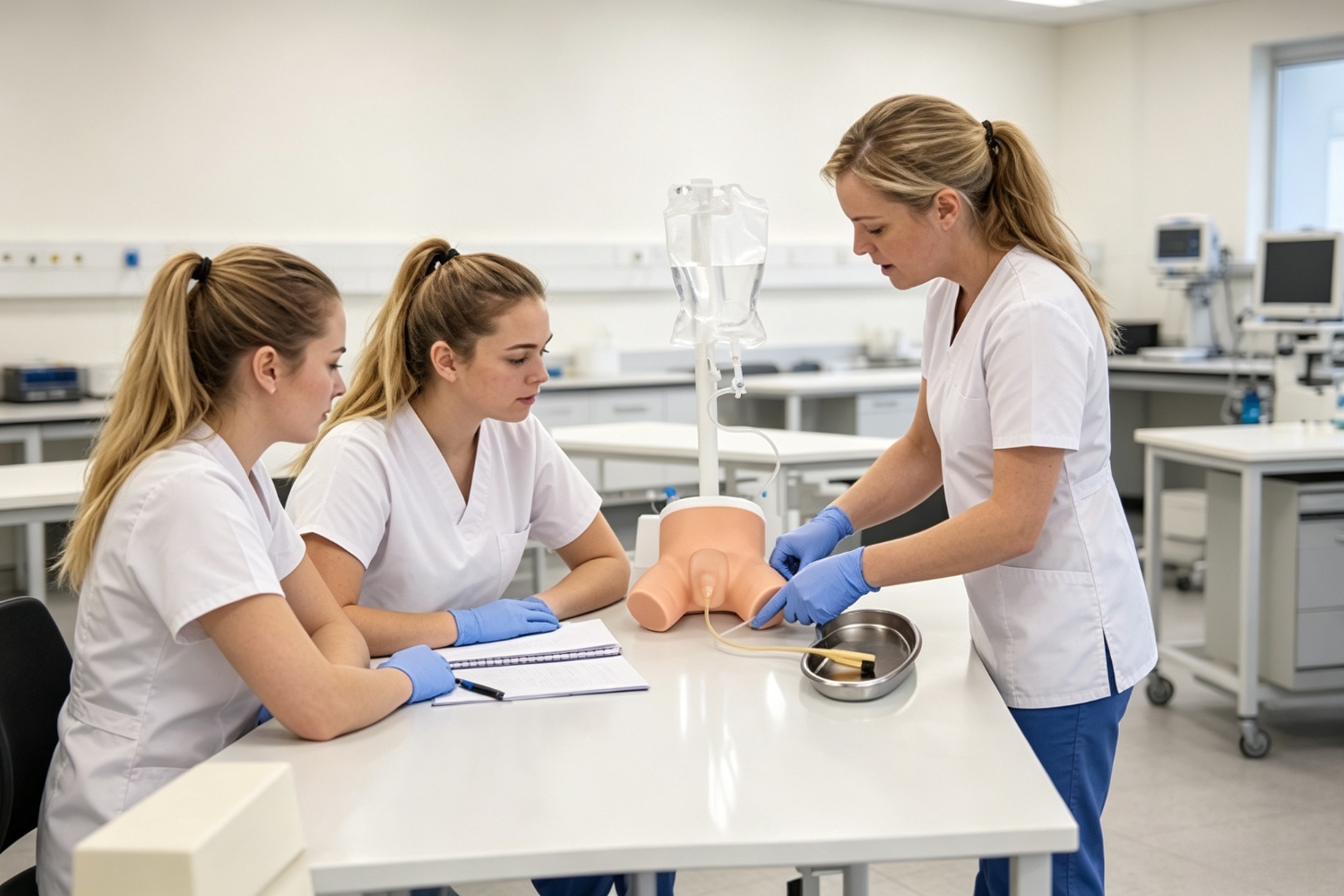
Urinary catheterization training is most effective when the individual skills are incorporated into a structured learning progression rather than taught as a single isolated procedure.
A typical training sequence may include:
1. Learn the anatomy
Learners identify the urinary structures, urethral meatus, bladder location, and anatomical differences between patient populations.
2. Observe the procedure
An instructor demonstrates positioning, equipment preparation, catheter handling, insertion, and drainage management.
3. Practice individual skills
Learners practice specific components such as meatus identification, catheter positioning, Foley insertion, balloon inflation, fixation, or drainage.
4. Perform the complete procedure
Learners combine the individual skills into a complete catheterization scenario.
5. Repeat the procedure
Repeated practice helps learners develop consistency, hand control, and familiarity with the equipment.
6. Receive feedback
Instructors can identify problems with positioning, catheter handling, aseptic technique, or procedural sequence.
7. Assess competency
Learners demonstrate the required skills in a structured skills lab, OSCE, or competency assessment according to their program requirements.
This approach is useful for nursing schools, medical education programs, simulation centers, and healthcare organizations that need repeatable practice environments.
What Should Learners Be Able to Demonstrate?
After appropriate instruction and practice, a urinary catheterization skills session may assess whether learners can:
- Identify relevant urinary anatomy
- Identify the urethral meatus
- Prepare the required equipment
- Apply appropriate aseptic technique
- Position the patient or training model appropriately
- Handle the catheter correctly
- Perform male or female catheterization as required
- Perform Foley catheter insertion when applicable
- Position the catheter appropriately
- Perform balloon inflation when applicable
- Recognize appropriate catheter placement
- Recognize simulated urine return or drainage
- Secure and manage the catheter
- Manage the drainage tubing
- Remove the catheter when required
- Respond appropriately to a difficult catheterization scenario
- Provide suprapubic catheter care when required
- Perform suprapubic bladder puncture when supported by the training model
Specific competency criteria should follow the learner's program, institutional policies, catheter manufacturer's instructions, and applicable clinical guidelines.
Build a More Complete Catheterization Skills Program
A single training model may not cover every urinary-care skill or patient population. Many nursing and healthcare education programs use a combination of anatomical models, functional catheterization trainers, and specialized models.
For example:
- Anatomy and meatus identification: use labeled models to introduce urinary anatomy and catheter pathways.
- Basic insertion: use male or female models for repeated catheterization practice.
- Foley catheter training: use compatible functional models that support catheter placement and balloon inflation.
- Fluid feedback: use models with simulated urine return to help learners recognize correct placement.
Combined adult training: use interchangeable male/female models when learners need experience with both anatomies. - Pediatric training: use infant-specific models for neonatal and pediatric catheterization.
- Geriatric training: introduce age-related anatomical changes and more challenging catheterization scenarios.
- Advanced urinary care: use multifunctional models for suprapubic catheter care and suprapubic bladder puncture.
This approach allows instructors to build training around specific competencies instead of requiring every learner to use the same model for every lesson.
Frequently Asked Questions
Q1: Can urinary catheterization models be used for nursing student training?
Yes. Urinary catheterization training models can support classroom demonstrations, nursing skills labs, repeated hands-on practice, OSCE preparation, and competency assessment. The specific skills available depend on the design of the model.
Q2: Can learners practice both male and female catheterization?
Yes. Some models are designed specifically for male or female practice, while interchangeable models allow learners to train on both anatomies. MedEduQuest offers individual and combined options.
Q3: Can learners practice Foley catheter insertion?
Yes, when the training model is designed for Foley catheter practice. Compatible models may support catheter placement, balloon inflation, drainage, and catheter removal.
Q4: Can learners practice balloon inflation?
Some Foley catheter training models support balloon inflation. The model should be specifically designed for this function, and learners should follow their program's protocol and the catheter manufacturer's instructions.
Q5: Can these models provide feedback during insertion?
Functional models with fluid systems can provide visible simulated urine return when the catheter is correctly positioned. This gives learners and instructors immediate feedback during practice.
Q6: Can learners practice aseptic technique?
The model can provide a controlled setting for practicing the procedural sequence and catheter handling while learners apply the aseptic technique taught by their program. Infection-prevention competency also depends on the learner's overall technique and adherence to institutional protocols.
Q7: Is there a model for infant catheterization?
Yes. Infant-specific male, female, and combined male/female models are available for pediatric and neonatal nursing education.
Q8: Is there a model for difficult geriatric catheterization?
Yes. A specialized geriatric female model can reproduce anatomical changes such as a recessed urethral opening and reduced tissue elasticity to provide a more challenging practice scenario.
Q9: Can learners practice suprapubic catheter care?
Yes. Selected multifunctional urinary catheterization simulators support suprapubic catheter care in addition to routine urethral catheterization.
Q10: Can learners practice suprapubic bladder puncture?
Some advanced urinary catheterization simulators are designed for suprapubic bladder puncture practice. This capability depends on the specific model.
.jpeg?w=1500&h=1500)
.jpeg?w=1600&h=1600)
.jpeg?w=1500&h=1500)
.jpeg?w=1600&h=1600)
.jpg?w=1600&h=1600)
.jpg?w=1600&h=1600)
.jpg?w=1600&h=1600)
.jpg?w=1600&h=1600)
.jpg?w=1500&h=1500)
.jpg?w=1500&h=1500)
.jpg?w=1600&h=1600)
-0.jpg?w=1500&h=1500)
.jpeg?w=1600&h=1600)
.jpeg?w=1600&h=1600)
.jpeg?w=1600&h=1600)
.jpeg?w=1600&h=1600)
.jpeg?w=1600&h=1600)
.jpeg?w=1600&h=1600)
.jpg?w=1600&h=1600)
.jpg?w=1600&h=1600)
.jpg?w=1000&h=1000)
.jpg?w=1000&h=1000)
.jpeg?w=1500&h=1500)
.jpeg?w=1500&h=1500)
.jpeg?w=1600&h=1600)
.jpeg?w=1600&h=1600)
.jpg?w=1600&h=1600)
.jpg?w=1600&h=1600)
.jpg?w=1500&h=1500)
.jpg?w=1500&h=1500)
.jpg?w=1500&h=1500)
.jpg?w=1500&h=1500)
.jpg?w=1500&h=1500)
.jpg?w=1500&h=1500)
.jpg?w=1500&h=1500)
.jpg?w=1500&h=1500)